Showing posts with label bob dylan. Show all posts

Friday, May 31, 2024

Bob Dylan - Songs For Dwarf Music (Stereo Mix) UPGRADE


Bob Dylan - Songs For Dwarf Music

(soniclovenoize stereo Basement Tapes reconstruction)

JUNE 2024 UPGRADE


Side A:

1.  Million Dollar Bash

2.  Yea! Heavy and a Bottle of Bread

3.  Please Mrs. Henry

4.  Crash on The Levee

5.  Lo and Behold!

6.  Tiny Montgomery

7.  This Wheels On Fire


Side B:

8.  You Ain't Going Nowhere

9.  I Shall Be Released

10.  Too Much of Nothing

11.  Tears of Rage

12.  Quinn The Eskimo

13.  Open The Door, Homer

14.  Nothing Was Delivered


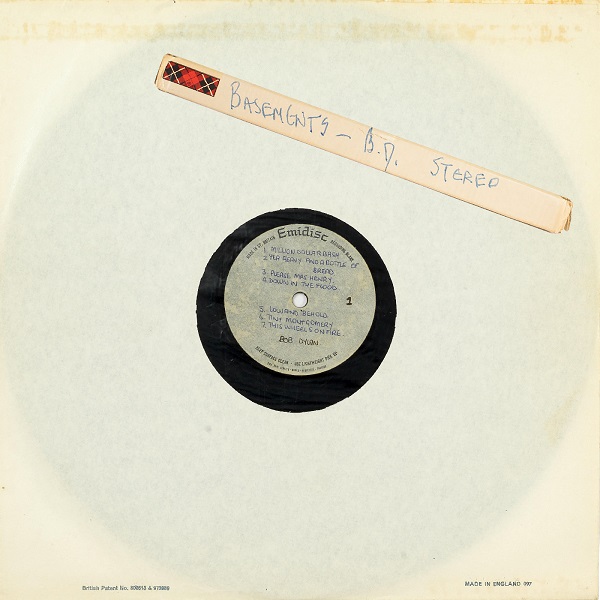
This upgrade is an explicitly stereo reconstruction of the 14-song acetate compiled in January 1968 of Bob Dylan’s Basement Tapes recordings for his music publishing company, Dwarf Music.  Intended for distribution to recording industry insiders in order to shop the songs around for other artists to cover, it was this acetate that was used to create the very first bootleg album, Great White WonderMany believe this specific collection is the closest official word to a vintage, proper Dylan album compiled from the 1967 Basement Tapes recordings.  While the pristine mono master of Garth Hudson’s original fourteen-song acetate was released as a vinyl-only RSD exclusive in 2015, this reconstruction attempts to make an exclusively stereo version of Hudson’s master.  Sourced from the bootlegged two-track masters leaked on several bootlegs and mixed with modern techniques, we are able to make a centralized stereo mix with Dylan’s vocal centered, the bass panned to the right and the keyboards and backing vocals panned left.  


Infamously concluding his electric, amphetamine-fueled 1966 World Tour with a “debilitating” motorcycle accident, Bob Dylan was left to retire from the public eye and become the family-man he allegedly always wanted to be.  But his old desire to make music eventually crept in, which amounted to Dylan placing phone calls systematically to the members of The Hawks, his backing band for his previous tour.  Being on retainer, Robbie Robertson, Garth Hudson, Rick Danko and Richard Manuel—whom themselves were thinking about regrouping and renaming their own outfit into The Band—arrived to Dylan’s Woodstock home in the summer of 1967 and began simply jamming to old country, gospel and traditional standards while the world around them snacked on psychedelic pop.  Hudson recorded the highlights of the proceedings for posterity to two-track tape and the quintet quickly amassed a pile of reels, unsure exactly what to do with them.  The Basement Tapes were born.


But without a new Dylan album or tour on the horizon, manager Albert Grossman needed new product.  Thus the gears eventually shifted and the daily basement jams evolved into demo sessions for new Dylan compositions, intended to be sold to other artists.  Even though Dylan tailor-wrote each serious original for a specific artist, his originals were very different during this period, informed by the structure of the folk standards the quintet had jammed on during the previous months.  Dylan’s lyrics were paired down from the verbose poetics of Blonde on Blonde to be concise, with every singular line being important and justified; many songs became structurally and even thematically similar to sea shanties and drinking songs.  But the most notable characteristics are the full band arrangements, which often included: Dylan’s 12-string acoustic guitar and idiosyncratic voice; Rick Danko’s electric bass keeping the rhythm in Levon Helm's absence, reminiscent of Sun Records' drumless recordings; Richard Manuel’s piano keeping the backbone with Dylan’s acoustic; only Robbie Robertson’s tasteful electric lead guitar and Garth Hudson’s celestial electric organ remained from the previous year’s 'wild mercury sound’.  Remarkably, some of Bob Dylan’s most cherished songs spawned from these sessions and the Basement Tapes set the standard for Dylan’s concise songwriting method and style for his following albums, from John Wesley Harding up to Planet Waves


The first collection of demos was compiled by Hudson (who was acting as impromptu producer) in October 1967, a set of ten songs from Reels 8 & 9, sequenced in the order they were recorded (although “Tiny Montgomery” from Reel 4 was stuck in-between): Million Dollar Bash / Yea! Heavy and a Bottle of Bread / Please Mrs. Henry / Crash on the Levee / Lo and Behold! / Tiny Montgomery / This Wheel’s On Fire / You Ain’t Going Nowhere / I Shall Be Released / Too Much of Nothing.  It was this original tape that secured the initial covers of the Basement Tapes material, including Flatt & Scruggs take on “Crash on the Levee”, Brian Auger & The Trinity’s take on “This Wheel’s On Fire”, The Byrds take on “You Ain’t Going Nowhere” and Peter, Paul & Mary’s take on “Too Much of Nothing.”


With The Byrds and Peter, Paul & Mary charting with Dylan originals, Albert Grossman asked for more songs.  A second, five-song tape was compiled in January 1968 with the best songs from Reels 10 & 13 that included: Tears of Rage / Quinn The Eskimo / Open The Door, Homer / Nothing Was Delivered / Get Your Rocks Off.  Eventually the final song was dropped, and the remaining four songs were tagged onto the end of the previous 10-song reel, creating the final 14-song acetate that lead to Manfred Mann’s take on “Quinn The Eskimo” charting as well as The Byrds take on “Nothing Was Delivered”.  It was this 14-song configuration that made the most rounds in the inner circles, arriving not only in the hands of both music industry professionals and curious musicians, but in the hands of Jann Wenner who famously published an article about the great unreleased Bob Dylan album in Rolling Stone.   It also arrived in the hands of Ken and Dub who pressed their own  vinyl run of the material (coupled with recordings from 1961) and sold their wares under-the-counter to drooling Dylan fans starving for the originals of his currently-charting originals otherwise were unavailable to the general public.  Eventually dubbed The Great White Wonder, this was the first bootleg record. 


The mythology of The Basement Tapes grew throughout the 60s and 70s, largely due to the notoriety of those specific Dylan songs he never released, Wenner’s Rolling Stone article and the emergence of bootleg recordings.  Meeting the demands for an official document of the Basement Tapes recordings, Robbie Robertson with Levon Helm (who did not appear in the Basement Tapes sessions until the 14-song acetate was completed) compiled and then overdubbed a double album of the recordings in 1975.  While a great listen, the inherent faults of the album (anachronistic overdubs, poor sound quality of some source material, inclusions of unrelated Band material, exclusion of “I Shall Be Released” and “Quinn the Eskimo”) did not quench many Dylan fans’ thirst for the vintage Basement Tapes recordings.  Since then, a number of bootlegs including A Tree With Roots and The Genuine Basement Tapes offered a more vintage anthology of the available material.  Both sets were finally trumped by the official 6-CD box set The Bootleg Series vol 11: The Basement Tapes Complete, remastered (mostly) from the master reels, presented as a rather limited stereophonic mix with the vocal track panned at two-o-clock and the remaining track panned at eighto-clock.  The epic box set was everything a Basement Tapes aficionado would desire, but it lacked one thing: a remastered reproduction of that original fourteen-song acetate for Dwarf Music, the recording that started it all, what many Dylan fans believe is the true missing Dylan album from 1967. 


While I originally made a mono reconstruction of Hudson’s 14-song master for my blog in March of 2015–a facsimile based upon John Peel’s own copy as reference–I was soon trumped by the man himself, who released Hudson’s original mono master in all it’s analog glory, as an exclusive vinyl-only release for Record Store Day a month later!  For the last nine years, that released version had been my go-to cut of the material; but I wondered, although it was clearly meant to be in mono, was it possible to make a more modern stereo mix of this exact historical compilation?  It was a cumbersome task, as all of the tapes were tracked live to two-track tape, with Dylan’s acoustic and vocal in one track and all of the remaining instruments in the other track!  That end result, if mixed to stereo directly, is a difficult listen akin to the awkward mixes of early Beatles albums in which the vocals are trapped in one channel and instruments in the other.  


Regardless, I set out to make a more blanched stereo mix utilizing some more modern mixing techniques.  First and foremost, we will take the “utility” track that contains everything but the vocals, and split the bass frequencies into its own track.  Panning that to the right and the remaining frequencies to the left, we are able to make a stereo soundstage which could allow the vocals to be centered; but more importantly, in separating the bass frequencies and rebalancing the track, we are able to reveal and appreciate some of the intricacies that were otherwise overshadowed by Danko’s bass.  Particularly, Manuel’s piano now jumps out and Hudson’s magical organ becomes a near duet with Dylan’s vocal–not unlike his “Electric Trilogy” of albums!  An effect of the way I have created this soundstage is that the recordings are no longer bass-driven, as Danko’s bass is now balanced appropriately with either Manuel’s piano or Hudson’s organ.  This becomes a new way to listen to this album.  


Additionally, we are able to not only center Dylan’s vocal, but here we use a reverb plugin that uses an AI algorithm to sample and emulate specific room interiors, to replicate the unique reverb featured on Dylan’s vocals throughout the session (most likely the spring reverb on their PA).  Thus we are able to create a stereo spread of this reverb, giving these mixes more space and atmosphere, as well as more treble information to be coupled with the bass for the right channel.  


What songs should be included?  Luckily there is a lot of documentation that clarifies which takes were used and in what order, and we will follow that template (for better or for worse).  Side A of my reconstruction begins with take 2 of “Million Dollar Bash”, followed by take 2 of “Yea! Heavy and a Bottle of Bread”, “Please Mrs. Henry”, take 2 of “Crash on the Levee”, take 2 of “Lo and Behold!”, “Tiny Montgomery” and “This Wheel’s On Fire”.  Side B begins with take 2 of “You Ain’t Going Nowhere” followed by take 2 of “I Shall Be Released”.  Take 1 of “Too Much of Nothing” was used on the acetate (as opposed to take 2 featured and overdubbed on the 1975 Basement Tapes album) and Peter, Paul and Mary’s cover version logically reflects that arrangement.  Likewise, take 1 of “Tears of Rage” (as opposed to take 3 on the 1975 Basement Tapes album) and take 1 of “Quinn The Eskimo” (as opposed to the superior take 2 on Biograph and The Essential Bob Dylan) were both featured on the original acetate.  This reconstruction concludes with takes 1 of “Open The Door, Homer” and (regrettably) take 1 of “Nothing Was Delivered”.  While I don’t totally agree on these take selections (notably for “Nothing Was Delivered” and “Quinn The Eskimo”) we will concede to present an accurate artifact. 


Sources used:

A Tree With Roots

The Genuine Basement Tapes


flac --> wav --> editing in SONAR and Goldwave --> flac encoding via TLH lv8

* md5 files, track notes and artwork included


LISTEN FOR FREE AT MY PATREON 


Thursday, November 23, 2023

Bob Dylan - New York Skyline


Bob Dylan - New York Skyline

(New Morning double-album re-imagining)


Side A:

  1. The Man in Me

  2. Winterlude

  3. Mary Anne

  4. One More Weekend

  5. Mr. Bojangles


Side B:

  1. Tomorrow is a Long Time

  2. Three Angels

  3. The Ballad of Ira Hayes

  4. If Dogs Run Free


Side C:

  1. New Morning

  2. Lily of The West

  3. Alligator Man

  4. I Went To See The Gypsy

  5. Sign On The Window


Side D:

  1. Time Passes Slowly

  2. Father of Night

  3. If Not For You

  4. Long Black Veil

  5. Spanish is The Living Tongue 


Happy Thanksgiving!  This re-imagining was voted by my top-tier Patreons to be the November 2023 release on Albums That Never Were, so here it is!  I call this New York Skyline, which is a double-album re-imagining of Bob Dylan’s 1970 classic album New Morning.  The first disc is a reconstruction of Al Kooper’s original cut of the New Morning album, as he envisioned it near the conclusion of the sessions; the second disc was constructed by myself, comprising the best of the rest of the material not featured on Al Kooper’s cut, assembled as the second half of a theoretical double album which compliments the first half.  


As the curtain closed on the 1960s, one of its founding fathers, Bob Dylan, attempted to close the curtain on his own legacy.  After reinventing his songwriting during his legendary Basement Tapes “sessions” throughout 1967, Dylan returned with a more concise and direct approach, abandoning the “thin, wild, mercury sound” for influences derived from The Great American Songbook.  This was immediately seen in 1968’s John Wesley Harding, which replaced his epic, surreal poetics for more concise Americana with a stately, sparse instrumentation.  1969’s Nashville Skyline took the progression even farther, embracing commercial Country and Western music, recorded in said city and featuring a new “Dylan voice” that seemed to be reminiscent of the classic crooners of a bygone era, if not Kermit The Frog.  


But the real trip began with the release of Self Portrait in June, 1970.  A double album that contained a seemingly random mix of more Nashville standards, classic Americana traditionals embellished by studio musicians, confusingly scant originals like “Wigwam” or “All The Tired Horses” and live recordings with The Band from their 1969 Isle of Wight performance.  Divisive to this day, with Rolling Stone’s Greil Marcus famously prefacing his review of the album with “What is this shit?”, Dylan seemed to be intentionally dismantling the legend he had built for himself throughout the 1960s, either out of frustration, boredom, or even his own amusement.  While this is a fair assessment, it also misses a key nuance: New Morning.


In the spring of 1970, Dylan was drafted to compose the music for a new Archibold MacLeish play called Scratch, based upon Stephen Vincent Benet’s short story The Devil and Daniel Webster.  Although Dylan eventually bowed out of the production due to creative differences with the producers, he had salvaged three new key compositions that created the momentum for a new album: “New Morning”, “Father of Night” and “Time Passes Slowly”.  


Dylan returned to the studio a month before the release of the intentionally divisive Self Portrait,  demoing material for an album to harbor the Scratch leftovers.  Armed with Nashville veterans Russ Kunkle on drums, Charlie Daniels on bass, Al Kooper on keyboards, and an old-pal guitarist named George Harrison, Dylan breezed through a few of his new compositions, including  “Sign On The Window”, “Time Passes Slowly”, “I Went To See The Gypsy”, and a song he had co-written with Harrison, “If Not For You.”  The session also included a jam of a number of 50s Rock n Roll standards and Bob Dylan classics, to varying degrees of success.  


A literal week before the release of Self Portrait, Dylan began the sessions proper, assembling a backing band with Kooper, Daniels and Krunkle, and the addition of Dave Bromberg on guitar and a set of female backing vocalists.  A tad looser than the previous year’s Nashville Skyline sessions, the vibe was distinct from Dylan’s previous work and continued the laid back, yet nuanced instrumentation from the final Self Portrait sessions.  Featured heavily are a trio of female backing vocalists, a sound that would re-emerge later in Dylan’s career.  Dylan’s voice had a more natural and less forced inflection, sounding both road-weary yet optimistic–a surviving pop-philosopher of the turbulent decade that had just concluded.  Although he was still in his “Nashville-era”, these recordings seemed to be decidedly “New York”.  Although intending to record his new originals, he put just as much work into even more Country covers and American standards.  Knowing this, these sessions–which would form the basis of his 1970 album New Morning–were more a direct continuation of Self Portrait, rather than a reevaluation.  


The first day of the week’s recording yielded the traditional songs “Mary Anne” and “Sarah Jane”, Jimmy Newman’s “Alligator Man” and Peter la Farge’s “The Ballad of Ira Hayes”.  The second day of recording yielded Dylan’s own “If Not For You” and “Time Passes Slowly”, a cover of Jerry Jeff Walker’s “Mr. Bojangles” and the traditional “Spanish is the Living Tongue”, a song Dylan seemed to have a vast affinity for.   Day three saw the recording of Dylan’s own “One More Weekend”, as well as the traditionals “Jamaica Goodbye” and “Lily of The West”, the classic Elvis Presely ballad “Can’t Help Falling in Love With You” and Lefty Frizell’s “Long Black Veil.”  Day four of recording saw Dylan’s own “Three Angels”, “Tomorrow is a Long Time” and “New Morning”, as well as Ledbelly’s “Bring Me A Little Water, Sylvie” and Joni Mitchel’s “Big Yellow Taxi.”  The fifth and final marathon recording session yielded a number of masters: Dylan originals “If Dogs Run Free”, “I Went To See The Gypsy”, “Sign On The Window”, “Winterlude”, “The Man In Me” and “Father Of Night”, as well as Elvis Presley’s “I Forgot To Remember To Forget” and a new, sparser version of “Lily of The West.”  


With approximately 25 finished songs recorded over five days, New Morning Was basically a wrap three days before Self Portrait was even released.  At this time, Dylan’s current musical compatriot Al Kooper assembled a rough acetate of how he envisioned the album, which included: “The Man In Me”, “Winterlude”, “Mary Anne”, “One More Weekend”, “Mr Bojangles”, “Tomorrow is a Long Time”, “Three Angels”, “The Ballad of Ira Hayes” and “If Dogs Run Free.”  


After experiencing (or relishing?) the blow-back from Self Portrait, it was decided that New Morning still needed more work and producer Bob Johnson oversaw a pair of sweetening sessions in July which saw horn overdubs on “New Morning”, string overdubs on “Sign On The Window” and Bluegrass instrumentation to “If Not For You.”  One final recording session in August with a hastily-assembled band of Dylan, Kooper, Harvey Brooks and Buzzy Feiten yielded new versions of “If Not For You” and “Time Passes Slowly”, as well as a newly-written original concerning Dylan’s honorary Princeton doctorate “Day of The Locusts.”  Refining the tracklist to include only the twelve Dylan originals, New Morning was released in October, and fans were assured that Dylan hadn’t “lost it”--even if New Morning wasn’t anything near the intimacy of John Wesley Harding or the power of Blonde On Blonde.  Seven of the covers from the New Morning sessions appeared in the slightly-unauthorized 1973 album Dylan (which was also marketed as A Fool Such As I), and the remandiner stayed in the vault until Dylan’s recent Bootleg Series and COpyright Extension collections.  Has the sun set on this new morning, or is it time for a reappraisal?  


This re-imagination attempts to offer a reassessment of this “lesser” Dylan album that holds a very specific place in my heart; although not his best work of the period, the sound was unique and its vibe is very comfy–not to mention harnessing my favorite “Dylan voice” which he would not precisely repeat.  I offer this revised, double album New Morning to counter the narrative that the album was meant to silence the critics that hated Self Portrait, and suggest it as a literal continuation, for better or for worse.  The first disc is a reconstruction of Al Kooper’s master of the album, with a second disc assembled from the remaining sessions, to complement Kooper’s master.  We are also presuming the album was completely finished in July, and thus the August 1970 session was not needed.  


Reconstructing Al Kooper’s master, Side A opens with Jeffery Lebowski’s theme, “The Man In Me”, followed by “Winterlude”, both from New Morning.  This is followed by “Mary Anne” taken from Dylan (A Fool Such As I), EQd to match the rest of this reconstruction.  Next is “One More Weekend”, again from New Morning, and the side concluding with “Mr Bojangles”, again re-EQd from Dylan.  Side B opens with “Tomorrow Is A Long Time”, sourced from a 2007 leak of the pre-mastered reels, the best source for the song.  This is followed by “Three Angels” from New Morning and “The Ballad of Ira Hayes” re-EQd from Dylan.  Disc one ends with the far superior version of “If Dogs Run Free”, taken from The Bootleg Series Volume 10, which suggests angelic longing rather than crappy scatty jazz-pop.  Bob, what were you even thinking?  


With a ton of material leftover from Kooper’s cut, my goal was to make a second disc that matches and compliments his selections (much like my reconstruction of Hendrix’s First Rays of The New Rising Sun); it is not intended to be a complete retrospective of these sessions.  Side C opens with the brass overdubbed version of “New Morning” from The Bootleg Series Volume 10, followed by the more atmospheric, alternate take of “Lily of The West” from The 50th Anniversary Collection.  Although one could consider it a blemish, here in the tracklist “Alligator Man” becomes a good-time uplift, also taken from The 50th Anniversary Collection.  My personal favorite take 1 of “Went To See The Gypsy” from the June 5th session follows, also from The 50th Anniversary Collection.  Closing the side is the orchestral version of “Sign on The Window” from The Bootleg Series Volume 10.


Side D opens with one of the best recordings of these sessions, which was so surprisingly ignored by Dylan: the hard rock version of “Time Passes Slowly” from The Bootleg Series Volume 10.  Here a deep-cut rather than an album closer, “Father of Night” from New Morning is next.  Mid-side we have “If Not For You”, but I am using what take I felt fit the best in this context: take 2 from the June 2nd session, taken from the 50th Anniversary Collection.  “Long Black Veil”, also from the 50th Anniversary collection, follows, and the album closes with a serene end of “Spanish is The Living Tongue”, also taken from the 2007 premaster leak.  


Sources used:

The 50th Anniversary Collection: 1970 (2020 CD release)

A Few Files From a Data DVD Disc (bootleg, 2007)

The Bootleg Series Volume 10 (2013 CD release)

Dylan (A Fool Such As I) (2013 CD Remaster)

New Morning (2009 CD remaster)


LISTEN TO IT AT OUR PATREON SITE

http://patreon.com/AlbumsThatNeverWere

Thursday, December 31, 2020

Bob Dylan - Renaldo & Clara Soundtrack

Bob Dylan – Renaldo and Clara Soundtrack

(soniclovenoize reconstruction)


Side A:

1. When I Paint My Masterpiece

2. Isis

3. A Hard Rain’s a-Gonna Fall

4. It Ain’t Me Babe

5. It Takes A Lot To Laugh, It Takes a Train To Cry

6. Romance in Durango


Side B:

7. One More Cup of Coffee (Valley Below)

8. Sara

9. Never Let Me Go

10. Tangled Up In Blue

11. Just Like a Woman

12. Knockin’ On Heaven’s Door


Happy Year’s Eve-- only 12 hours to go, depending on your time zone! Let’s end this garbage year with the third of a trilogy of famous live albums that never were, in remembrance of the recently deceased concept of live music. This is a reconstruction of the theoretical soundtrack to the unreleased 1978 Bob Dylan film Renaldo & Clara, which contained vignettes and live footage recorded on the first leg of the Rolling Thunder Revue in 1975. Sourced primarily from the Rolling Thunder Revue boxset, this reconstruction presents how a single-disc soundtrack to the film could have been presented, featuring solely the live performances of Dylan and his band. All songs have been volume adjusted for cohesiveness, presented in film order and structured as two continuous sides of a musical performance.

Following his 1970’s renaissance—jumpstarted by the critically acclaimed Blood on the Tracks album—Dylan longed for one of the things he never had: a stable backing band. Hanging out in 1975 at New York nightclub/coffeehouse/music venue The Other End, Dylan took note of Patti Smith’s backing band and desired to form one of his own for Blood On The Tracks’ follow-up. Working with playwright Jacques Levy (another patron of The Other End), Dylan had crafted an album’s worth of new material worthy to follow Blood on The Tracks, albeit less personal and decidedly more cinematic. Recruiting bassist Rob Stoner & drummer Howard Wyeth from The Other End and violinist Scarlet Rivera literally on a street corner, Dylan had the core of his band in place. With the addition of budding songstress Emmylou Harris on backing vocals and a series of session musicians to round out the ensemble, recording sessions for the Desire album commenced in July 1975. At first chaotic with too many musicians chiming into Dylan’s newer—and longer—songs, Stoner suggested stripping the band to the aforementioned core; by the end of the month, they had the majority of the album in the can.

But some Dylanologists suggest Desire was a means to an end, with the goal being touring again with a band of his own. That fall, the core of Dylan, Stoner, Wyeth and Rivera were enhanced by guitarists Mick Ronson, T Bone Burnett and Steven Soles, multi-instrumentalist David Mansfield and percussionist Luther Rix. Another The Other End recruit, Ronee Blakley, came aboard to fill Emmylou Harris’s position, who was not able to tour due to her own career and session work. After returning to the studio to record a less libelous version of “Hurricane," the ragtag group hit the road with a pair of Halloween shows at the War Memorial Auditorium in Plymouth, MA. But this was no ordinary rock concert; joining was a star-studded musical cast to create an old-time music revue, including Joan Baez, Roger McGuinn, Bob Neuwirth, Ramblin Jack Elliott and Joni Mitchell, each getting a slice of the spotlight before Dylan's headline. Even Allen Ginsburg tagged along to open the show with some poetry!

Another guest that tagged along was filmmaker Howard Alk. He was no stranger to filming Dylan on the road, having also been the cameraman behind Don’t Look Back and Eat The Document. This time there was (in theory) an actual script co-written by Dylan and director Sam Shepard, although live footage of the tour would eventually be juxtaposed in the film. But by “script”, we mean more of a conceptual outline, as Dylan and Shepard would more encourage the actors—band members entourage of the Rolling Thunder Revue—to improvise scenes while on tour.

What exactly were these scenes? Many of the tour members themselves did not know, but simply went along with Dylan because, well, he was Dylan! The ringleader himself was cast as the protagonist Renaldo and his soon-to-be ex-wife Sara Dylan, the sad eyed lady of the Lowlands herself, as Clara. Completing a love triangle was The Woman in White, played by Dylan’s former flame Joan Baez. It is generally assumed that the trio and the surrounding characters were somehow acting out the stories of the songs, or at least the underlying emotions of the songs. Additionally, the songs themselves seemed to create a vague narrative for the trio’s love triangle, based on the song order as presented in the final film. Throughout, Dylan wore whiteface makeup, and sometimes a mask; he insisted the meaning of it was in the lyrics of the songs.

If none of this makes any sense, there was at least one amazing constant: the live performances themselves. Dylan daringly stocked his set with Desire tracks, months before the album was even released. The performances were energetic, intense and intimate, ranging from the proto-punk “Isis” to the gentle “Oh Sister.” Likewise, Dylan and his backing band—dubbed Guam—also presented updated versions of Dylan staples such as “It Ain’t Me Babe” and “A Hard Rain’s a-Gonna Fall” that made his The Band-backed Before The Flood seem like yacht rock. Furthermore, Dylan was mostly free from guitar duties due to the triple guitar attack of Ronson, Burnett and Soles. Urged on by Patti Smith, Dylan used his new-found bodily freedom to act out the lyrics, flailing his arms and motioning his hands as extensions of his lyrical prowess.

After a Fall and Winter of essentially one of the most powerful stage shows Dylan had presented, this first leg of the Rolling Thunder Revue ended at Madison Square Garden on December 8th, and the band earned a rest. Reconvening in April 1976 for a second leg of the tour, Guam had a slight face lift after the exit of Blakley and Rix, replaced by Donna Weiss and Gary Burke, respectively. Likewise, the setlist received a significant face lift as well, drawing more on amped-up and Desire-ified versions of Dylan’s back catalog. While well-intended, this second leg of the Rolling Thunder Revue was dynamic and it was obvious the concept—and band itself—was losing steam. The tour concluded in May, building to a live performance filmed and recorded for an NBC television special and released that September as the ragged live album Hard Rain, both of which were not well-received.

Doing as he would after his 1966 tour, Dylan retired to his home studio to personally edit the footage shot while on tour to try and make a film out of it himself. What Dylan came up with was Renaldo & Clara, a surreal four-hour film: part live concert, part documentary, part improvised drama... understood only by Dylan himself. With a limited release in January 1978, Renaldo & Clara received unanimous negative praise, resulting in the limited release to end after only two weeks. Later that year, Dylan offered a more concise two-hour edit of the film, exorcising much of the ambiguous dramatic vignettes and focusing on the stellar live performances. This did not save the film, as this edit, too, was critically panned and never saw an official release beyond a few broadcasts and theater showings. It seemed that Renaldo & Clara suffered a same fate as 1967’s Eat The Document: an amazing document of Dylan’s live accomplishments, confusingly edited as an experimental film, critically panned and stuffed in the vault, surviving only on bootleg reels and VHS tapes.

But that wasn’t quite the end of Renaldo & Clara; released in 2002 as The Bootleg Series Volume 5: Bob Dylan Live, The Rolling Thunder Revue, a number of the performances featured in Renaldo & Clara eventually saw the light of day. A much more enthralling document of the tour and righting the wrong of Hard Rain, fans ‘desired’ more footage from the first leg of the tour. In 2019, famed director Martin Scorsese reedited the original footage from 1975 into a completely new documentary, Rolling Thunder: A Bob Dylan Story by Martin Scorsese. Finally, fans were able to see remastered and crystal-clear performances from the legendary first leg of The Rolling Thunder Revue, thanks to Scorsese’s curation. But, in true Dylan form, not all in the documentary was what it appeared to be, as several interviewees and narrative events raised numerous eyebrows. To coincide with the film, Dylan released a 14-disc box set containing all six of the professionally-recorded shows on the 1975 tour, two discs of rehearsals and an additional disc of live rarities from the era. But what about the actual presumptive soundtrack to Renaldo & Clara? Can it be salvaged?

Using mostly the mixes found on the Rolling Thunder box set, we are able to easily create a Renaldo & Clara soundtrack. Since the contents of the actual film are an overwhelming mess and honestly a taxing listen, we will limit this soundtrack album to a single-disc of only the featured Dylan performances—essentially, the only reason anyone would want to watch Renaldo & Clara in the first place! We will also sequence the performances in the order in which they were featured in the film and crossfade the performances to create two continuous performances in each side of the record. The resulting album is essentially the very best of the best of Dylan’s live tours, what I believe would have been actually released in 1978 had the film not been canned. When paired with the rougher document of the 1976 leg of the tour, Hard Rain, you have a pretty great document of this era, as there is no song-overlap between the two albums.

Side A opens with the very first performance from the very first concert of the tour: “When I Paint My Masterpiece” from 10/25/75, taken from the bootleg Plymouth Rock, but EQd to match the sound of the version in Wolfgang’s Vault (presumably sourced from the superior master tape). Next is the fantastic “Isis” from 12/4/75; although featured on Masterpieces and recently on Side Tracks, I chose the new mix found on the Rolling Thunder box for coherency purposes. The electric stomp of “A Hard Rain’s a-Gonna Fall” also from 12/4/75 and the exquisite “It Ain’t Me Babe” from 11/20/75 follows, with the 11/21/75 “It Takes a Lot To Laugh” afterwards. The side concludes with “Romance in Durango” from 12/4/75; note that although we are using the mix from the Rolling Thunder box, I have edited out the second-to-last verse in which Dylan made a vocal flub, as it was heard in the actual film and originally released on Masterpieces. Side B starts with “One More Cup of Coffee”, “Sara” and “Never Let Me Go”, all from 12/4/75. Dylan’s superbly intimate “Tangled Up in Blue” from 11/21/75 is next, with the album ending with a pair of tracks from 11/20/75, “Just Like a Woman” and “Knockin on Heaven’s Door.” 


Sources used:

Plymouth Rock (bootleg, 1997 Colosseum Records)

The Rolling Thunder Review: The 1975 Recordings (2019 Columbia Records)


flac --> wav --> editing in SONAR Pro and Goldwave --> flac encoding via TLH lv8
* md5 files, track notes and artwork included

Wednesday, August 29, 2018

Bob Dylan - Medicine Sunday


Bob Dylan – Medicine Sunday

(soniclovenoize reconstruction)


Side A:
1.  Can You Please Crawl Out Your Window?
2.  I Wanna Be Your Lover
3.  Freeze Out
4.  One Of Us Must Know (Sooner Or Later)
5.  New York Instrumental #1

Side B:
6.  Positively 4th Street
7.  Brand New Leopard-Skin Pill-Box Hat
8.  I’ll Keep It With Mine
9.  She’s Your Lover Now


This is a reconstruction of a theoretical album consisting of the early sessions for Bob Dylan’s seminal 1966 album Blonde On Blonde.   Abandoning most of these New York-based recording sessions with The Band in favor of rerecording with session musicians in Nashville, these early sessions represent a different sound that would emerge on Blonde On Blonde -- looser but more energetic, closer to a studio capture of Bob Dylan’s live sound in 1965 and 1966.   Using the best sources possible, most tracks feature unique edits and mixes I have created to offer a more finished album with a modern stereophonic soundstage. 

After his ascension from folk hero to rock star with his groundbreaking “Like a Rolling Stone” and its accompanying album Highway 61 Revisited, Bob Dylan buckled down and rode the wave, intending to continue pushing the boundaries of rock music with symbolic, obtuse and intertextual lyrics, juxtaposed with a driving rock rhythm section and the twin chime of electric guitar and Hammond organ.  For that, he would need a band.  His ad hoc assemblage of players for his infamously electric July 1965 Newport Folk Festival performance, including Al Kooper and members of the Paul Butterfield Blues Band, were not available to continue.  After recommendations from a few associates, Dylan recruited a group of Canadian rockers--Levon and The Hawks--to back him for the national concerts in support of Highway 61 Revisited, who would later rebrand themselves as The Band. 

Meanwhile, Dylan’s management and label continued to feed the machine and keep this new “electric Dylan” product flowing.  Just two months after the release of “Like a Rolling Stone”, “Positively 4th Street” was released as its follow-up single in September 1965.  Despite being simply an outtake from the Highway 61 Revisited sessions from July, the song was a Top 10 hit and is considered one of Dylan’s most cherished tracks.  With fear of losing momentum, Dylan was whisked back into the studio to pump out his next single.  This time Dylan brought with him The Hawks, attempting to capture the electricity from his current live shows.

Unfortunately, Dylan had blown through all of his good material.  Bob and his band gathered on October 5th to woodshed new material at Columbia Studios in New York, but with dismal results: two song fragments, “Jet Pilot” and “Medicine Sunday” (the later evolving into “Temporary Like Achilles”); a merely semi-interesting Robby Robertson-led instrumental; and a scant jam of another Highway 61 Revisited leftover “Can You Please Crawl Out Your Window?”.  The only cut of real value tracked on this day was “I Wanna Be Your Lover”, an electrifying and rollicking tribute (or parody?) of the Fab Four, who allegedly influenced Dylan to form a backing band in the first place.  Sometime after the session, drummer Levon Helm left The Hawks, fed up with being a sidesman, as well as the confrontational audiences on Dylan’s tour.

Returning to the studio on November 30th with session drummer Bobby Gregg (whom had already backed Dylan on both Bringing It All Back Home and Highway 61 Revisited) and a brand new composition he believed to be one of his best, Dylan was revitalized to create a follow-up single.  Dylan had a special feeling about his latest epic poem “Freeze Out”—later retitled to “Visions of Johanna”—and special care was given to find the perfect arrangement.  Dylan struggled to find the right sound for the song with The Hawks, and the group plowed through a number of completely different arrangements: Take 4 was a slow, uncertain romp that began quietly with just Dylan on electric guitar, adding instruments as the song built to a rocking end; Take 5 was a more organized version of the previous take, but lacked the suspense, danger and dynamic; Take 7 slowed the tempo but succumbed to typical bar rock trope; Take 8 was an icy, electric march with bursts of celeste; Take 14 was slowed down to ballad territory, the closest to its finial incarnation on Blonde On Blonde.  Despite having several great takes—all sounding completely different (especially 4, 8 and 14)—Dylan was not satisfied with “Freeze Out” and set it aside… temporarily.  Instead, the band focused on a new uptempo arrangement of “Can You Please Crawl Out Your Window?”, nailing Take 10, which was rush released as a single in December.  It was a flop, stalling at #58 on the charts.

Refocusing his attention from a single to an album, Dylan reconvened with The Hawks (this time with fill-in drummer Sandy Konikoff) on January 21st, 1966, armed with new material intended to populate this follow-up LP.  Beginning with another heartbreak-themed long-form poem, Dylan searched for the thin, wild mercury sound to accompany it.  “Just Another Glass Of Water”—later published as “She’s Your Lover Now”—could have been one of Dylan’s masterpieces on Blonde On Blonde, on par with “Sad Eyed Lady of the Lowlands”.  But Dylan could not find the sound he was looking for, struggling not only to communicate his ideas but for The Hawks to interpret him.  Take 15 came very close, before breaking down halfway through the fourth verse.  Exasperated, Dylan called off the session, the song lost forever.  Before leaving the studio, Dylan recorded a demo of the complete 8-minute composition alone at a piano, at the very least immortalizing his idea before it was abandoned forever. 

The next session on January 21st was more productive.  With Bobby Gregg back behind the kit, the group hammered out another new Dylan composition, this time a tongue-in-cheek tribute to the Memphis Blues.  Nailed in presumably one take, “Brand New Leopard-Skin Pill-Box Hat” seemed to fit The Hawks as this steady yet bombastic recording tops the eventual Nashville version released on Blonde on Blonde, in this listener’s humble opinion.  Moving on to a dynamic breakup ballad driven by Paul Griffin’s exquisite piano, “One Of Us Must Know (Sooner or Later)” was eventually perfected by Take 24.  Again rush-released as a single in February, the song did moderately well, charting at #33. 

It was now obvious that the fruits of these New York sessions with the Hawks were few and far between and Dylan grew weary of only stumbling across the right arrangements.  An additional session on January 27th proved mostly uneventful, resulting in yet another song fragment, “Lunatic Princess”.   Despite the previous week’s results, a remake of “Leopard-Skin Pill-Box Hat” was attempted as well, but Dylan was not even bothered to see it through completion.  Finally, Dylan takes his band through a mere rehearsal of a magnificent song dating back to the initial acoustic Bringing It All Back Home sessions almost exactly a year earlier.  “I’ll Keep It With Mine” is loose, beginning with Dylan solo at a piano, with The Hawks individually coming in as they figured out the changes.  With only this single run-through, Dylan was done with the band—and this city—for recording his follow-up. 

At producer Bob Johnston’s suggestion, Dylan relocated to Nashville in February and March to finish the album that was barely begun, only bringing Robby Robertson and Al Kooper along.  Re-recording both “Visions of Johanna” and “Leopard-Skin Pill-Box Hat”—as well as a sudden wealth of brand new compositions—Dylan completed Blonde On Blonde.  Released to universal acclaim as Dylan’s masterpiece, the only New York recording to make the cut was “One Of Us Must Know”, a tombstone to the album Blonde On Blonde could have been under different conditions.  Is it possible to reconstruct what a New York Blonde On Blonde would have sounded like?

For this reconstruction—which I have named Medicine Sunday, after the song fragment which isn’t actually featured here—we will try to create a single-LP follow-up to Highway 61 Revisited from these late ‘65/early ’66 sessions.  Since the sessions were obviously never completed, it will be difficult to make a complete-sounding album.  The only rule we will implement is to include material with some sort of precedent on other Dylan albums.  Hence, all of the one-minute  song fragments (“Jet Pilot”, “Medicine Sunday” and “Lunatic Princess”) will be excluded, as not only is there no precedent, but their inclusion would make Medicine Sunday sound less complete.  With a lack of finished material, we will have to look at two filler-tracks: the untitled instrumental (here I appropriately titled “New York Instrumental #1”) and “Positively 4th Street”.  While it is true Dylan is known for his distinctive voice and lyric, Dylan would go on to release instrumentals on both Nashville Skyline and Self Portrait.  Just as well, “Positively 4th Street”, while not a part of the New York sessions proper, was the current single at the time.  It is conceivable the label might have included it on the LP anyways as a cash cow, as previous singles like “Like a Rolling Stone” was included on Highway 61 Revisited and “One of Us Must Know” was included on Blonde On Blonde. 

Side A begins with the lead single from these sessions, “Can You Please Crawl Out Your Window?”.  Using the complete semi-stereo version found on The Bootleg Series Vol 12: The Cutting Edge, here I have widened the stereo spectrum to further separate the instruments to an ideal nine and three o’clock.  It is followed by “I Wanna Be Your Lover”, again taken from The Cutting Edge with the stereo spectrum widened.  Take 8 of “Visions of Johanna” (here we use its original working title “Freeze Out”) from The Bootleg Series Vol 8: No Direction Home follows, a version that tops the Blonde On Blonde recording in my humble opinion.  Next is my own personal remix of “One of Us Must Know” from the multitrack stems, as provided on The Cutting Edge.  My mix attempts to replicate the balance of the original mono mix, while retaining a modern stereophonic image with a centered drum track.  Likewise, I have replicated the edit before the third verse, only ever heard on the rare mono single mix; thus, this is the first time that original edit has ever appeared in stereo!  Side B concludes with “New York Instrumental #1” as a sort of intermission, again taken from The Cutting Edge with a widened stereophonic spectrum.

Much like many album from the 60s, Side B begins with the previously-released single “Positively 4th Street”, the original stereo mix taken from Side Tracks but with its stereo spectrum narrowed to match the rest of the album.  Next is “Leopard-Skin Pill-Box Hat”, taken from No Direction Home, a personal favorite as aforementioned.  Next is “I’ll Keep It With Mine”, taken from The Cutting Edge; in order to make this recording more complete, I have edited out Dylan’s vocal flub in the intro, as well as extracted and patched Bob Johnston’s talk-back interruption during verse one.  Despite being a mere rehearsal and probably meant to have a more thorough and defined arrangement, this recording works as a loose arrangement precursor, as we would soon hear similarly-relaxed Dylan arrangements on The Basement Tapes and New Morning.  Medicine Sunday appropriately concludes with the epic that never was, “She’s Your Lover Now”.  Using pieces of Takes 15 and 16 on The Cutting Edge, I was able to create a complete performance of the song by editing a proper intro onto take 15 and crossfading into take 16 at the point where the band trails off, hopefully giving the illusion that The Hawks intentionally stopped playing and Dylan finished the song solo.  A further edit was made at the outro so that Dylan concludes with the tonic of the song, giving it a resolve and a remorseful vocal improvisation to end the album.  


Sources used:
Bootleg Series Vol 8: No Direction Home (2005)
Bootleg Series Vol 12: The Cutting Edge (2015 Collector’s Edition)
Side Tracks (2013)


Flac --> wav --> mixing & editing in SONAR Pro & Goldwave --> flac encoding via TLH lv8
*md5, artwork and tracknotes included