Showing posts with label folk. Show all posts

Friday, May 31, 2024

Bob Dylan - Songs For Dwarf Music (Stereo Mix) UPGRADE


Bob Dylan - Songs For Dwarf Music

(soniclovenoize stereo Basement Tapes reconstruction)

JUNE 2024 UPGRADE


Side A:

1.  Million Dollar Bash

2.  Yea! Heavy and a Bottle of Bread

3.  Please Mrs. Henry

4.  Crash on The Levee

5.  Lo and Behold!

6.  Tiny Montgomery

7.  This Wheels On Fire


Side B:

8.  You Ain't Going Nowhere

9.  I Shall Be Released

10.  Too Much of Nothing

11.  Tears of Rage

12.  Quinn The Eskimo

13.  Open The Door, Homer

14.  Nothing Was Delivered


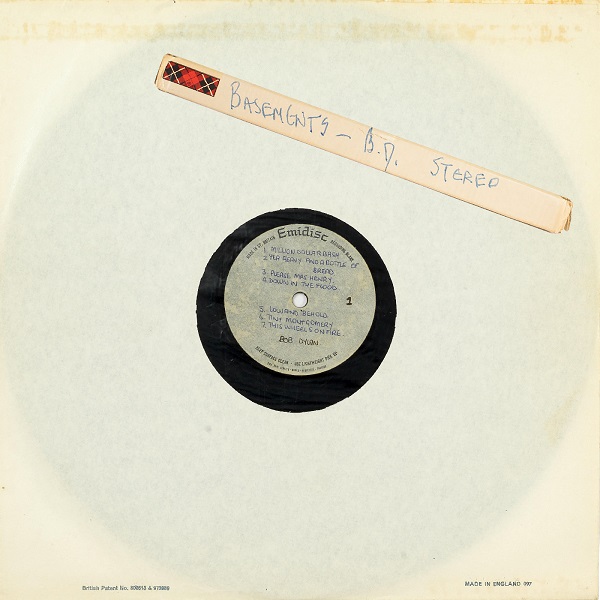
This upgrade is an explicitly stereo reconstruction of the 14-song acetate compiled in January 1968 of Bob Dylan’s Basement Tapes recordings for his music publishing company, Dwarf Music.  Intended for distribution to recording industry insiders in order to shop the songs around for other artists to cover, it was this acetate that was used to create the very first bootleg album, Great White WonderMany believe this specific collection is the closest official word to a vintage, proper Dylan album compiled from the 1967 Basement Tapes recordings.  While the pristine mono master of Garth Hudson’s original fourteen-song acetate was released as a vinyl-only RSD exclusive in 2015, this reconstruction attempts to make an exclusively stereo version of Hudson’s master.  Sourced from the bootlegged two-track masters leaked on several bootlegs and mixed with modern techniques, we are able to make a centralized stereo mix with Dylan’s vocal centered, the bass panned to the right and the keyboards and backing vocals panned left.  


Infamously concluding his electric, amphetamine-fueled 1966 World Tour with a “debilitating” motorcycle accident, Bob Dylan was left to retire from the public eye and become the family-man he allegedly always wanted to be.  But his old desire to make music eventually crept in, which amounted to Dylan placing phone calls systematically to the members of The Hawks, his backing band for his previous tour.  Being on retainer, Robbie Robertson, Garth Hudson, Rick Danko and Richard Manuel—whom themselves were thinking about regrouping and renaming their own outfit into The Band—arrived to Dylan’s Woodstock home in the summer of 1967 and began simply jamming to old country, gospel and traditional standards while the world around them snacked on psychedelic pop.  Hudson recorded the highlights of the proceedings for posterity to two-track tape and the quintet quickly amassed a pile of reels, unsure exactly what to do with them.  The Basement Tapes were born.


But without a new Dylan album or tour on the horizon, manager Albert Grossman needed new product.  Thus the gears eventually shifted and the daily basement jams evolved into demo sessions for new Dylan compositions, intended to be sold to other artists.  Even though Dylan tailor-wrote each serious original for a specific artist, his originals were very different during this period, informed by the structure of the folk standards the quintet had jammed on during the previous months.  Dylan’s lyrics were paired down from the verbose poetics of Blonde on Blonde to be concise, with every singular line being important and justified; many songs became structurally and even thematically similar to sea shanties and drinking songs.  But the most notable characteristics are the full band arrangements, which often included: Dylan’s 12-string acoustic guitar and idiosyncratic voice; Rick Danko’s electric bass keeping the rhythm in Levon Helm's absence, reminiscent of Sun Records' drumless recordings; Richard Manuel’s piano keeping the backbone with Dylan’s acoustic; only Robbie Robertson’s tasteful electric lead guitar and Garth Hudson’s celestial electric organ remained from the previous year’s 'wild mercury sound’.  Remarkably, some of Bob Dylan’s most cherished songs spawned from these sessions and the Basement Tapes set the standard for Dylan’s concise songwriting method and style for his following albums, from John Wesley Harding up to Planet Waves


The first collection of demos was compiled by Hudson (who was acting as impromptu producer) in October 1967, a set of ten songs from Reels 8 & 9, sequenced in the order they were recorded (although “Tiny Montgomery” from Reel 4 was stuck in-between): Million Dollar Bash / Yea! Heavy and a Bottle of Bread / Please Mrs. Henry / Crash on the Levee / Lo and Behold! / Tiny Montgomery / This Wheel’s On Fire / You Ain’t Going Nowhere / I Shall Be Released / Too Much of Nothing.  It was this original tape that secured the initial covers of the Basement Tapes material, including Flatt & Scruggs take on “Crash on the Levee”, Brian Auger & The Trinity’s take on “This Wheel’s On Fire”, The Byrds take on “You Ain’t Going Nowhere” and Peter, Paul & Mary’s take on “Too Much of Nothing.”


With The Byrds and Peter, Paul & Mary charting with Dylan originals, Albert Grossman asked for more songs.  A second, five-song tape was compiled in January 1968 with the best songs from Reels 10 & 13 that included: Tears of Rage / Quinn The Eskimo / Open The Door, Homer / Nothing Was Delivered / Get Your Rocks Off.  Eventually the final song was dropped, and the remaining four songs were tagged onto the end of the previous 10-song reel, creating the final 14-song acetate that lead to Manfred Mann’s take on “Quinn The Eskimo” charting as well as The Byrds take on “Nothing Was Delivered”.  It was this 14-song configuration that made the most rounds in the inner circles, arriving not only in the hands of both music industry professionals and curious musicians, but in the hands of Jann Wenner who famously published an article about the great unreleased Bob Dylan album in Rolling Stone.   It also arrived in the hands of Ken and Dub who pressed their own  vinyl run of the material (coupled with recordings from 1961) and sold their wares under-the-counter to drooling Dylan fans starving for the originals of his currently-charting originals otherwise were unavailable to the general public.  Eventually dubbed The Great White Wonder, this was the first bootleg record. 


The mythology of The Basement Tapes grew throughout the 60s and 70s, largely due to the notoriety of those specific Dylan songs he never released, Wenner’s Rolling Stone article and the emergence of bootleg recordings.  Meeting the demands for an official document of the Basement Tapes recordings, Robbie Robertson with Levon Helm (who did not appear in the Basement Tapes sessions until the 14-song acetate was completed) compiled and then overdubbed a double album of the recordings in 1975.  While a great listen, the inherent faults of the album (anachronistic overdubs, poor sound quality of some source material, inclusions of unrelated Band material, exclusion of “I Shall Be Released” and “Quinn the Eskimo”) did not quench many Dylan fans’ thirst for the vintage Basement Tapes recordings.  Since then, a number of bootlegs including A Tree With Roots and The Genuine Basement Tapes offered a more vintage anthology of the available material.  Both sets were finally trumped by the official 6-CD box set The Bootleg Series vol 11: The Basement Tapes Complete, remastered (mostly) from the master reels, presented as a rather limited stereophonic mix with the vocal track panned at two-o-clock and the remaining track panned at eighto-clock.  The epic box set was everything a Basement Tapes aficionado would desire, but it lacked one thing: a remastered reproduction of that original fourteen-song acetate for Dwarf Music, the recording that started it all, what many Dylan fans believe is the true missing Dylan album from 1967. 


While I originally made a mono reconstruction of Hudson’s 14-song master for my blog in March of 2015–a facsimile based upon John Peel’s own copy as reference–I was soon trumped by the man himself, who released Hudson’s original mono master in all it’s analog glory, as an exclusive vinyl-only release for Record Store Day a month later!  For the last nine years, that released version had been my go-to cut of the material; but I wondered, although it was clearly meant to be in mono, was it possible to make a more modern stereo mix of this exact historical compilation?  It was a cumbersome task, as all of the tapes were tracked live to two-track tape, with Dylan’s acoustic and vocal in one track and all of the remaining instruments in the other track!  That end result, if mixed to stereo directly, is a difficult listen akin to the awkward mixes of early Beatles albums in which the vocals are trapped in one channel and instruments in the other.  


Regardless, I set out to make a more blanched stereo mix utilizing some more modern mixing techniques.  First and foremost, we will take the “utility” track that contains everything but the vocals, and split the bass frequencies into its own track.  Panning that to the right and the remaining frequencies to the left, we are able to make a stereo soundstage which could allow the vocals to be centered; but more importantly, in separating the bass frequencies and rebalancing the track, we are able to reveal and appreciate some of the intricacies that were otherwise overshadowed by Danko’s bass.  Particularly, Manuel’s piano now jumps out and Hudson’s magical organ becomes a near duet with Dylan’s vocal–not unlike his “Electric Trilogy” of albums!  An effect of the way I have created this soundstage is that the recordings are no longer bass-driven, as Danko’s bass is now balanced appropriately with either Manuel’s piano or Hudson’s organ.  This becomes a new way to listen to this album.  


Additionally, we are able to not only center Dylan’s vocal, but here we use a reverb plugin that uses an AI algorithm to sample and emulate specific room interiors, to replicate the unique reverb featured on Dylan’s vocals throughout the session (most likely the spring reverb on their PA).  Thus we are able to create a stereo spread of this reverb, giving these mixes more space and atmosphere, as well as more treble information to be coupled with the bass for the right channel.  


What songs should be included?  Luckily there is a lot of documentation that clarifies which takes were used and in what order, and we will follow that template (for better or for worse).  Side A of my reconstruction begins with take 2 of “Million Dollar Bash”, followed by take 2 of “Yea! Heavy and a Bottle of Bread”, “Please Mrs. Henry”, take 2 of “Crash on the Levee”, take 2 of “Lo and Behold!”, “Tiny Montgomery” and “This Wheel’s On Fire”.  Side B begins with take 2 of “You Ain’t Going Nowhere” followed by take 2 of “I Shall Be Released”.  Take 1 of “Too Much of Nothing” was used on the acetate (as opposed to take 2 featured and overdubbed on the 1975 Basement Tapes album) and Peter, Paul and Mary’s cover version logically reflects that arrangement.  Likewise, take 1 of “Tears of Rage” (as opposed to take 3 on the 1975 Basement Tapes album) and take 1 of “Quinn The Eskimo” (as opposed to the superior take 2 on Biograph and The Essential Bob Dylan) were both featured on the original acetate.  This reconstruction concludes with takes 1 of “Open The Door, Homer” and (regrettably) take 1 of “Nothing Was Delivered”.  While I don’t totally agree on these take selections (notably for “Nothing Was Delivered” and “Quinn The Eskimo”) we will concede to present an accurate artifact. 


Sources used:

A Tree With Roots

The Genuine Basement Tapes


flac --> wav --> editing in SONAR and Goldwave --> flac encoding via TLH lv8

* md5 files, track notes and artwork included


LISTEN FOR FREE AT MY PATREON 


Thursday, December 31, 2020

Bob Dylan - Renaldo & Clara Soundtrack

Bob Dylan – Renaldo and Clara Soundtrack

(soniclovenoize reconstruction)


Side A:

1. When I Paint My Masterpiece

2. Isis

3. A Hard Rain’s a-Gonna Fall

4. It Ain’t Me Babe

5. It Takes A Lot To Laugh, It Takes a Train To Cry

6. Romance in Durango


Side B:

7. One More Cup of Coffee (Valley Below)

8. Sara

9. Never Let Me Go

10. Tangled Up In Blue

11. Just Like a Woman

12. Knockin’ On Heaven’s Door


Happy Year’s Eve-- only 12 hours to go, depending on your time zone! Let’s end this garbage year with the third of a trilogy of famous live albums that never were, in remembrance of the recently deceased concept of live music. This is a reconstruction of the theoretical soundtrack to the unreleased 1978 Bob Dylan film Renaldo & Clara, which contained vignettes and live footage recorded on the first leg of the Rolling Thunder Revue in 1975. Sourced primarily from the Rolling Thunder Revue boxset, this reconstruction presents how a single-disc soundtrack to the film could have been presented, featuring solely the live performances of Dylan and his band. All songs have been volume adjusted for cohesiveness, presented in film order and structured as two continuous sides of a musical performance.

Following his 1970’s renaissance—jumpstarted by the critically acclaimed Blood on the Tracks album—Dylan longed for one of the things he never had: a stable backing band. Hanging out in 1975 at New York nightclub/coffeehouse/music venue The Other End, Dylan took note of Patti Smith’s backing band and desired to form one of his own for Blood On The Tracks’ follow-up. Working with playwright Jacques Levy (another patron of The Other End), Dylan had crafted an album’s worth of new material worthy to follow Blood on The Tracks, albeit less personal and decidedly more cinematic. Recruiting bassist Rob Stoner & drummer Howard Wyeth from The Other End and violinist Scarlet Rivera literally on a street corner, Dylan had the core of his band in place. With the addition of budding songstress Emmylou Harris on backing vocals and a series of session musicians to round out the ensemble, recording sessions for the Desire album commenced in July 1975. At first chaotic with too many musicians chiming into Dylan’s newer—and longer—songs, Stoner suggested stripping the band to the aforementioned core; by the end of the month, they had the majority of the album in the can.

But some Dylanologists suggest Desire was a means to an end, with the goal being touring again with a band of his own. That fall, the core of Dylan, Stoner, Wyeth and Rivera were enhanced by guitarists Mick Ronson, T Bone Burnett and Steven Soles, multi-instrumentalist David Mansfield and percussionist Luther Rix. Another The Other End recruit, Ronee Blakley, came aboard to fill Emmylou Harris’s position, who was not able to tour due to her own career and session work. After returning to the studio to record a less libelous version of “Hurricane," the ragtag group hit the road with a pair of Halloween shows at the War Memorial Auditorium in Plymouth, MA. But this was no ordinary rock concert; joining was a star-studded musical cast to create an old-time music revue, including Joan Baez, Roger McGuinn, Bob Neuwirth, Ramblin Jack Elliott and Joni Mitchell, each getting a slice of the spotlight before Dylan's headline. Even Allen Ginsburg tagged along to open the show with some poetry!

Another guest that tagged along was filmmaker Howard Alk. He was no stranger to filming Dylan on the road, having also been the cameraman behind Don’t Look Back and Eat The Document. This time there was (in theory) an actual script co-written by Dylan and director Sam Shepard, although live footage of the tour would eventually be juxtaposed in the film. But by “script”, we mean more of a conceptual outline, as Dylan and Shepard would more encourage the actors—band members entourage of the Rolling Thunder Revue—to improvise scenes while on tour.

What exactly were these scenes? Many of the tour members themselves did not know, but simply went along with Dylan because, well, he was Dylan! The ringleader himself was cast as the protagonist Renaldo and his soon-to-be ex-wife Sara Dylan, the sad eyed lady of the Lowlands herself, as Clara. Completing a love triangle was The Woman in White, played by Dylan’s former flame Joan Baez. It is generally assumed that the trio and the surrounding characters were somehow acting out the stories of the songs, or at least the underlying emotions of the songs. Additionally, the songs themselves seemed to create a vague narrative for the trio’s love triangle, based on the song order as presented in the final film. Throughout, Dylan wore whiteface makeup, and sometimes a mask; he insisted the meaning of it was in the lyrics of the songs.

If none of this makes any sense, there was at least one amazing constant: the live performances themselves. Dylan daringly stocked his set with Desire tracks, months before the album was even released. The performances were energetic, intense and intimate, ranging from the proto-punk “Isis” to the gentle “Oh Sister.” Likewise, Dylan and his backing band—dubbed Guam—also presented updated versions of Dylan staples such as “It Ain’t Me Babe” and “A Hard Rain’s a-Gonna Fall” that made his The Band-backed Before The Flood seem like yacht rock. Furthermore, Dylan was mostly free from guitar duties due to the triple guitar attack of Ronson, Burnett and Soles. Urged on by Patti Smith, Dylan used his new-found bodily freedom to act out the lyrics, flailing his arms and motioning his hands as extensions of his lyrical prowess.

After a Fall and Winter of essentially one of the most powerful stage shows Dylan had presented, this first leg of the Rolling Thunder Revue ended at Madison Square Garden on December 8th, and the band earned a rest. Reconvening in April 1976 for a second leg of the tour, Guam had a slight face lift after the exit of Blakley and Rix, replaced by Donna Weiss and Gary Burke, respectively. Likewise, the setlist received a significant face lift as well, drawing more on amped-up and Desire-ified versions of Dylan’s back catalog. While well-intended, this second leg of the Rolling Thunder Revue was dynamic and it was obvious the concept—and band itself—was losing steam. The tour concluded in May, building to a live performance filmed and recorded for an NBC television special and released that September as the ragged live album Hard Rain, both of which were not well-received.

Doing as he would after his 1966 tour, Dylan retired to his home studio to personally edit the footage shot while on tour to try and make a film out of it himself. What Dylan came up with was Renaldo & Clara, a surreal four-hour film: part live concert, part documentary, part improvised drama... understood only by Dylan himself. With a limited release in January 1978, Renaldo & Clara received unanimous negative praise, resulting in the limited release to end after only two weeks. Later that year, Dylan offered a more concise two-hour edit of the film, exorcising much of the ambiguous dramatic vignettes and focusing on the stellar live performances. This did not save the film, as this edit, too, was critically panned and never saw an official release beyond a few broadcasts and theater showings. It seemed that Renaldo & Clara suffered a same fate as 1967’s Eat The Document: an amazing document of Dylan’s live accomplishments, confusingly edited as an experimental film, critically panned and stuffed in the vault, surviving only on bootleg reels and VHS tapes.

But that wasn’t quite the end of Renaldo & Clara; released in 2002 as The Bootleg Series Volume 5: Bob Dylan Live, The Rolling Thunder Revue, a number of the performances featured in Renaldo & Clara eventually saw the light of day. A much more enthralling document of the tour and righting the wrong of Hard Rain, fans ‘desired’ more footage from the first leg of the tour. In 2019, famed director Martin Scorsese reedited the original footage from 1975 into a completely new documentary, Rolling Thunder: A Bob Dylan Story by Martin Scorsese. Finally, fans were able to see remastered and crystal-clear performances from the legendary first leg of The Rolling Thunder Revue, thanks to Scorsese’s curation. But, in true Dylan form, not all in the documentary was what it appeared to be, as several interviewees and narrative events raised numerous eyebrows. To coincide with the film, Dylan released a 14-disc box set containing all six of the professionally-recorded shows on the 1975 tour, two discs of rehearsals and an additional disc of live rarities from the era. But what about the actual presumptive soundtrack to Renaldo & Clara? Can it be salvaged?

Using mostly the mixes found on the Rolling Thunder box set, we are able to easily create a Renaldo & Clara soundtrack. Since the contents of the actual film are an overwhelming mess and honestly a taxing listen, we will limit this soundtrack album to a single-disc of only the featured Dylan performances—essentially, the only reason anyone would want to watch Renaldo & Clara in the first place! We will also sequence the performances in the order in which they were featured in the film and crossfade the performances to create two continuous performances in each side of the record. The resulting album is essentially the very best of the best of Dylan’s live tours, what I believe would have been actually released in 1978 had the film not been canned. When paired with the rougher document of the 1976 leg of the tour, Hard Rain, you have a pretty great document of this era, as there is no song-overlap between the two albums.

Side A opens with the very first performance from the very first concert of the tour: “When I Paint My Masterpiece” from 10/25/75, taken from the bootleg Plymouth Rock, but EQd to match the sound of the version in Wolfgang’s Vault (presumably sourced from the superior master tape). Next is the fantastic “Isis” from 12/4/75; although featured on Masterpieces and recently on Side Tracks, I chose the new mix found on the Rolling Thunder box for coherency purposes. The electric stomp of “A Hard Rain’s a-Gonna Fall” also from 12/4/75 and the exquisite “It Ain’t Me Babe” from 11/20/75 follows, with the 11/21/75 “It Takes a Lot To Laugh” afterwards. The side concludes with “Romance in Durango” from 12/4/75; note that although we are using the mix from the Rolling Thunder box, I have edited out the second-to-last verse in which Dylan made a vocal flub, as it was heard in the actual film and originally released on Masterpieces. Side B starts with “One More Cup of Coffee”, “Sara” and “Never Let Me Go”, all from 12/4/75. Dylan’s superbly intimate “Tangled Up in Blue” from 11/21/75 is next, with the album ending with a pair of tracks from 11/20/75, “Just Like a Woman” and “Knockin on Heaven’s Door.” 


Sources used:

Plymouth Rock (bootleg, 1997 Colosseum Records)

The Rolling Thunder Review: The 1975 Recordings (2019 Columbia Records)


flac --> wav --> editing in SONAR Pro and Goldwave --> flac encoding via TLH lv8
* md5 files, track notes and artwork included

Sunday, April 5, 2020

Small Faces - 1862

Small Faces – 1862

(soniclovenoize reconstruction)


Side A:
1.  Hello The Universal
2.  Donkey Rides, A Penny, A Glass
3.  Wide Eyed Girl On The Wall
4.  The Autumn Stone
5.  Evolution
6.  The War of The Worlds

Side B:
7.  Red Balloon
8.  What You Will
9.  Collibosher
10.  Growing Closer
11.  Wrist Job
12.  Wham Bam Thank You Ma’am


Continuing our weekly Social Distancing bonus reconstructions, this a long-requested one.  This is a reconstruction of the unfinished final Small Faces album, 1862.  Recorded throughout 1968, Small Faces broke up before finishing the album.  Several of the tracks would instead eventually appear on their posthumous 1969 collection The Autumn Stone.  This reconstruction attempts to present 1862 as a completed album, using the best quality stereo mixes of the material. 

After their smash hits of “Itchycoo Park” and “Tin Soldier”, the release of Small Faces third album Ogden’s Nut Gone Flake ushered the band into the emerging art-rock scene, being a psychedelic concept album with unique, circular packaging.  Its single “Lazy Sunday” charted to number two in 1968, making them one of the top bands in the UK.  Although the band felt they had already achieved their masterpiece, they returned to Trident studios with Glyn Johns to work on a follow-up album the day before Ogden’s release in May.  The theoretical fourth album was titled 1862, named after the metal plaque on the hundred-year-old chapel owned by Marriott, where the band rehearsed.  Top priority was a cover of Tim Hardin’s “Red Balloon”, a bittersweet folk ballad about heroin addiction.  Also tracked were two instrumentals, ambiguously named “Fred” and “Jack”, which the band never went back to finish.  

Several weeks later in June, the Small Faces went in to Olympic Studios to record a stopgap single between Ogden’s and 1862: the folk ballad “Hello The Universal” and the poppy rocker “Donkey Rides, A Penny, A Glass”.  An elaborate third song was recorded, “Wide Eyed Girl on the Wall”, but was apparently never completed, lacking vocals; like “Fred” and “Jack”, Small Faces never returned to complete the track.  The two finished songs were released as a single at the end of the month, but failed to mimic their previous success, despite being better compositions with more refined arrangement and production.  Furthermore, due to a pressing typo, “Hello The Universal” was misscredited simply as “The Universal”. 

Touring to support Odgen’s also proved difficult, as the material was just too complex to perform live.   Frontman Steve Marriott pitched the idea of adding a fifth member as a second guitarist, freeing himself to focus on singing—the prime candidate was Marriott’s friend Peter Frampton.  The rest of the band detested the idea, and they soldered on as a quartet.  Returning to Olympic in September, two more contrasting songs were tracked: the hard rocker of “Wham Bam Thank You Ma’am” and the pastoral folk ballad “The Autumn Stone.”  The band did not take so kindly to the former, with bassist Ronnie Lane storming out of the sessions and keyboardist Ian McLagan refusing to play on it.  Regardless, the heavy riff rock of “Wham Bam Thank You Ma’am” signaled the direction Marriott wanted to move in, and he brought in Nicky Hopkins to complete McLagan’s parts! 

In December, Glyn Johns invited the Small Faces to act as a backing band for French singer Johnny Hallyday and to record an album.  Being in a state of confusion, uncertainty and debt to their label, the band accepted but somehow found Peter Frampton joining their ranks from the recommendation of either Marriott or Johns.  In the course of the sessions, a few Marriott originals were worked up for Hallyday: a cover of an older Small Faces song “That Man” and two newer compositions, “Bang!” and “What You Will”.  The perceptions of the resultant album Riviere Ouvre Ton were contrasting; while McLagan and drummer Kenney Jones thought the sessions were awful, Marriott relished the opportunity to work with Frampton and took this as a sign to restart anew.  Marriott officially quit Small Faces, storming off stage on their New Years Eve performance. 

With perfect timing, Immediate Records released a new mix of “Afterglow”, backed with “Wham Bam Thank You Ma’am” (again misprinted as “Wham Bam Thank You Man”) in March 1969.  Marriott immediately formed a new group with Frampton called Humble Pie, with a decidingly heavier sound, as heard in “Wham Bam”.  Their debut single “Natural Born Bugie” featured a new recording of “Fred”, the instrumental from the May Trident sessions, now including a vocal and retitled “Wrist Job”.  Humble Pie’s debut album As Safe as Yesterday Is was released in August, which featured new recordings of “Bang” and “What You Will”, as well as folk jam “Growing Closer”, written as a collaboration between Frampton and McLagan, who had briefly rehearsed with Humble Pie before declining a position in the band.  Simultaneously, McLagan, Lane and Jones regrouped with new frontman Rod Stewart and future Rolling Stones guitarist Ronnie Wood as just simply the Faces.  By the end of the year, the quintet began recording their debut album, First Step, which had a very rootsy atmosphere.  While largely Stewart and Wood compositions, the 1970 album did feature an older Ronnie Lane original, “Stone”, which initially appeared as a collaboration with Pete Townshend as “Evolution” the previous year.    

Putting Faces and Humble Pie aside, Immediate also attempted a final cash grab for the Small Faces: a posthumous compilation album originally titled In Memorium, which contained some of the material recorded for 1862: “Red Balloon”, “Wide Eyed Girl on the Wall” and “The Autumn Stone.”  In Memorium also included a pair of songs long-attributed to 1862, but which were actually Ogden’s outtakes: “Call It Something Nice”, recorded at the very first Ogden’s session in April 1967, and “Collibosher”, recorded at the very last Odgen’s session in April 1968!  The Small Faces showed dismay for the morbid title, and Immediate withdrew and renamed the album The Autumn Stone, reissued as a double LP.  This edition added “The Universal” and “Wham Bam Thank You Ma’am”, now harboring most of the finished 1862 recordings.  Throughout the years, the twin instrumentals “Fred” and “Jack” made their way from the vaults to discount-bin anthology CDs, both mysteriously retitled to “The Pig Trotters” and “The War of The Worlds” without any band authorization.  This was the final say of 1862, its scraps littering The Autumn Stone and as various CD reissue bonus tracks and as a living mystery in the minds of Small Faces fans. 

Interestingly, some clues to 1862 were found in a blog post by Mick Taylor in 2008 regarding the backstory of the song “Red Balloon”; the blog post had some contribution from Toby Marriott, Steve’s son.  In the post, Toby mentions he had once read his father’s 1968 songbook, which stated the possible tracklist for 1862: “The Autumn Stone”, “Red Balloon”, “Collibosher”, “Buttermilk Boy”, “Wrist Job”, “Piccaninny”, “Wide Eyed Girl On The Wall”, “Donkey Rides, A Penny, A Glass” and a song only referenced as “Blues Jam.”  What is strange about this tracklist is its inclusion of the December 1966 outtake “Piccaninny”, severely out-of-date amongst the 1968 sessions, as well as “Buttermilk Boy”, recorded for As Safe as Yesterday Is.  Toby also mentions he no longer had the songbook, so he had to have been listing them from memory.  Can his recollection be trusted?  We will use this as a simple guidepost to reconstruct 1862 and try to logically fill in the gaps. 

For my reconstruction, we will take all these facts into account, but primarily intending to make an 1862 that sound musically cohesive.  We will also exclusively use Small Faces mixes found on the Here Come The Nice box set, being all stereo remixes that sound simply exquisite, as opposed to the crud on The Autumn Stone.  We will also rely on the several instrumental tracks, but we will appropriately fade them out to make them of a concise length and spread them throughout the album.  I have chosen to exclude both “Piccaninny” and “Call It Something Nice”, as they both pre-dated the recording sessions for 1862 and do not sonically sound identical enough to the rest of the material (although I will use “Collibosher”, as it was at least tracked in 1968).  Additionally, we will use some tracks from As Safe As Yesterday Is and First Step, since a few of their tracks dated from the 1862 era and, fortunately for us, sound sonically similar to the finished 1862 tracks anyways. 

Side A begins with the single that highlighted this era, “Hello The Universal” and “Donkey Rides, A Penny, A Glass,” both great introductions to the album.  Next, “Wide Eyed Girl On The Wall”, the stereo mix which has a new fade-out to match the mono mix, followed by “The Autumn Stone.”  Next I chose Face’s “Evolution” as not only does it feature most of the Small Faces, it could have very well been Ronnie Lane’s contribution to the original 1862 album since the song dated from around that time.  Side A dramatically closes with “The War of The Worlds”, faded out to make it an appropriate length. 

Side B begins with “Red Balloon”, another keystone song in 1862.  This is followed by the Humble Pie version of “What You Will” since the song was worked on by Small Faces during the Hallyday sessions, not to mention the song distinctly sounds like an 1862 song!  Although “Collibosher” dates from the final Ogden’s sessions, it does sound remarkably like an 1862 song, so I am including it here, again fading it out early to be concise.  Next, I’ve chosen “Growing Closer” from As Safe As Yesterday Is, as it could have been Ian McLagan’s contribution to the album, not to mention the acoustic and flute seemed to fit perfectly in the album!  Following is “Wrist Job”, using the Small Face’s instrumental instead of the Humble Pie lyrical version.  The album closes with a punch—“Wham Bam Thank You Ma’am”, in true stereo! 


Sources used:
Small Faces – Here Come The Nice (2014 Immediate Records box set)
Faces – First Step (2015 Rhino remaster)
Humble Pie – As Safe As Yesterday Is (2008 Repertoire Records remaster)


flac --> wav --> editing in SONAR Pro and Goldwave --> flac encoding via TLH lv8
* md5 files, track notes and artwork included